
Mineable L1 & social · CAPY
Capygram: a phone-mineable Layer 1 with a real social network attached
No presale, no VC round, no founder allocation — 288 trillion CAPY distributed entirely to miners, wrapped in a social platform that already runs eighteen live apps.
The short version
- —100% of supply goes to miners — no presale, no premine, no founder coins, no VCs
- —Mining runs free from a phone or web browser, with 12-hour sessions that continue offline
- —Two parallel programs (VTM and SCTM) split 288T CAPY 50/50, with 7 halvings each
What Capygram actually is
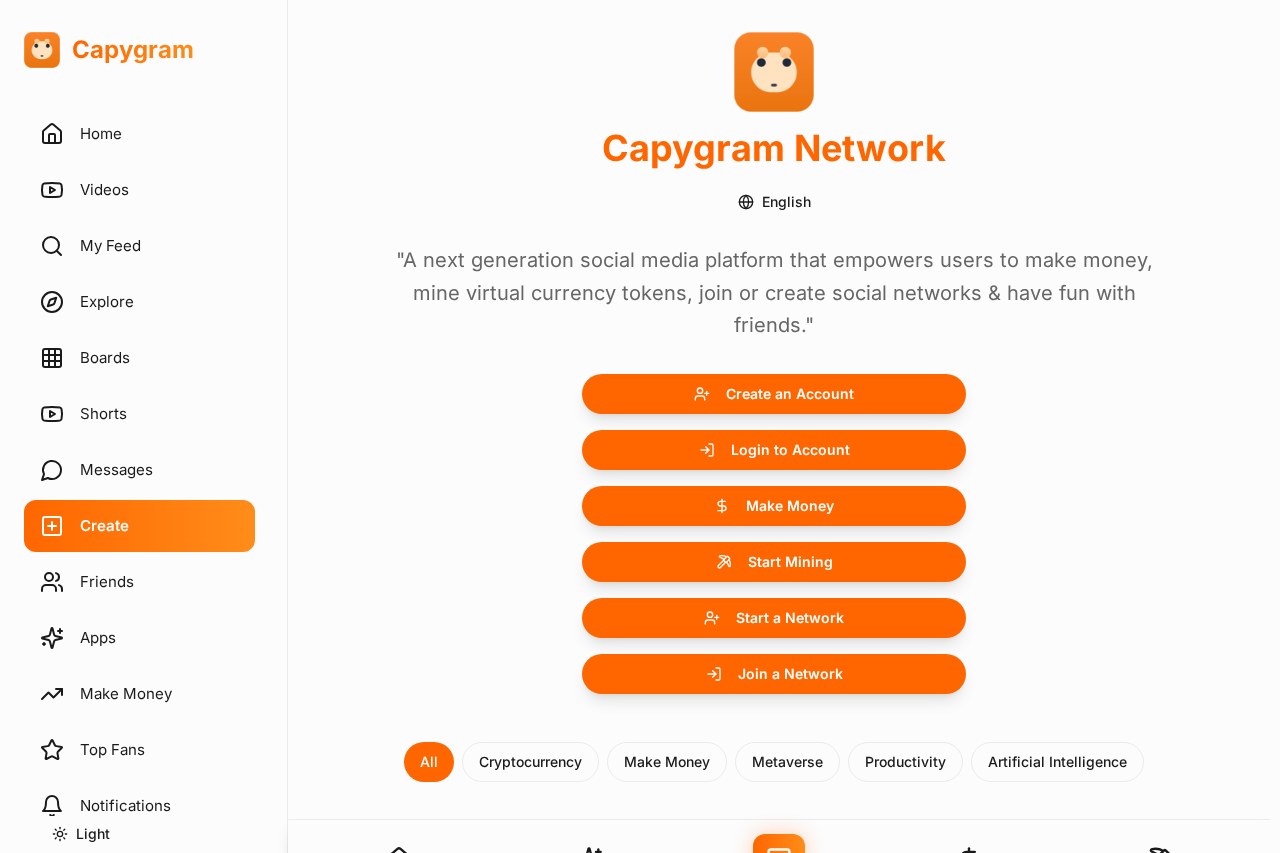
Capygram is two things bolted together, and understanding the review requires holding both in your head at once. At capygram.org sits the protocol: a phone-mineable Layer 1 blockchain that describes itself, without hedging, as "an innovative layer 1 blockchain and a new kind of money." At capygram.com sits the product: a social network that calls itself "a next generation social media platform that empowers users to make money, mine virtual currency tokens, join or create social networks and have fun with friends."
Most mineable-token projects are a landing page and a Telegram group. Most social networks with a token are a social network that bolted on a token. Capygram launched with the mining program living inside a functioning consumer product — Virtual Mining went live on Capygram.com on February 28th, 2026 — which means the distribution mechanism and the retention mechanism are the same mechanism. That is a structurally different bet from anything else in this category, and it is the reason this review scores the way it does.
The pitch to a new user is almost aggressively simple: sign up, mine for free within two minutes, no downloads, no hardware, no startup cost. Mining runs in the browser on any device, or on a phone, and sessions last twelve hours each and keep accruing from your account while you are offline. That is the entire barrier to entry. There is nothing to buy.
The distribution: 100% to miners, and they mean it
The tokenomics page is four lines long and it is the most important thing on the site. Max supply is 288,000,000,000,000 CAPY — 288 trillion. Allocation is 100% fair mining distribution, with no private allocations. The project states it in plain language: no VCs, no premine, no founder coins, no presale, no dev coins. Anyone can participate using a phone or a web browser without specialized equipment.
We have reviewed a great many projects that use the words "fair launch" while a fifth of supply sits in a team wallet behind a twelve-month cliff. The standard pattern in this sector — and you can read it off any comparable capybara-themed token's docs — is 25% presale, 15% marketing, 5% team, 20% CEX listing. Capygram has none of those line items, because there are no line items. There is one bucket and the miners are in it.
That single decision resolves the risk that sinks most consumer tokens. A network whose supply is majority-owned by funds that need an exit will eventually be operated against its own users. Capygram cannot be, because there is no insider position to defend. It also means there is no marketing war chest, no exchange-listing budget and no runway from a raise — which is a real cost, and we weight it below.
Two programs, seven halvings, and honest scarcity
The emission design is more thought-through than the friendly branding suggests. Supply is split 50/50 across two programs: Virtual Token Mining (VTM), which holds 144 trillion CAPY, and Smart Contract Token Mining (SCTM), which holds the other 144 trillion. VTM launched at genesis on February 28th, 2026. SCTM is slated to begin alongside mainnet, estimated June 28th, 2027, with the project explicitly noting it could land anywhere between February and June of that year.
Each program runs seven reward-halving events, so the emission rate becomes 128 times more scarce by the start of Cycle 8. Cycle lengths differ by program — 280 days for VTM, 180 days for SCTM — and full distribution for each program completes over 28 cycles. The published VTM halving schedule runs from December 5th, 2026 through July 12th, 2031; the SCTM schedule runs December 25th, 2027 through December 9th, 2030.
Two things stand out. First, the dates are published years in advance rather than vaguely gestured at, which is a low bar that most projects still fail to clear. Second, the project states outright that SCTM halving dates "might change based upon the actual launch date" — an admission of uncertainty that costs nothing to omit and that most teams do omit. Emission mechanics you can read in ninety seconds and verify against a calendar are worth more than a forty-page whitepaper nobody finishes.
The ecosystem is the retention engine
This is where Capygram separates from every other free-mining app. Capygram.com is not a mining dashboard with social features glued on the side; it is a full social platform — feed, videos, shorts, boards, messages, friends, events — with an app directory sitting on top of it. At the time of review, eighteen apps are live and categorized across Cryptocurrency, Make Money, Metaverse, Productivity and Artificial Intelligence.
CapyMining is app #1: mine tokens free from phone or browser, with mining power increased by building a referral network and holding daily check-in and mining streaks. Behind it sits a genuinely eclectic catalogue. CapyPets is virtual pet adoption with houses to upgrade. CapyFood lets you run a virtual restaurant, set prices in tokens, and earn when friends order. CapyHomes and CapyCars handle virtual property and vehicles. Then a stack of AI tools that would be a startup each on their own: CapyStyles for virtual outfit try-on, CapyImageEditor for background removal and enhancement, CapyToons for anime/comic/watercolor photo transforms, CapyDesigns for print-on-demand graphics, CapyWriter for long-form and social content. Plus CapyMemes, CapyPages, CapyQR, CapyResumes, CapyLinkInBio, CapyCalendar, CapyEvents and multiplayer ChessPro.
The strategic logic is sound and rarely executed. Free-mining tokens die when the only reason to open the app is to tap a button. Capygram gives you eighteen reasons, several of which are things people already pay monthly subscriptions for elsewhere, and the token is the internal currency across all of them — you set restaurant prices in tokens, you earn when friends order. The token has a use before it has a market.
Growth, and the roadmap that has to be delivered
Capygram reports a community spanning more than 150 countries and cites 99.9% uptime, and the growth mechanics are the well-understood ones: mining power scales with referral network depth and daily streak consistency, split across Tier 1 and Tier 2 referrals, layered over a CapyLevels progression system. Unique identity verification is part of the documented glossary, which matters enormously for a referral-driven mining program — sybil resistance is the failure mode that has killed every predecessor in this format.
The roadmap has three dated milestones and no filler. February 28th, 2026: Virtual Mining launches on Capygram.com. February 28th, 2027: one-year anniversary, marked as a "Big Pay Day Event." June 28th, 2027 (estimated): mainnet launch of the Capygram Layer 1 blockchain plus Smart Contract Token Mining. The published glossary already defines the machinery that milestone implies — virtual tokens versus mainnet tokens, withdrawal requests and the withdrawal request list, wallets, addresses, token destruction and DAO governance.
The FAQ is refreshingly blunt about the present state. It answers, directly, questions about what the token is priced at, where it can be purchased, sold and traded. Pre-mainnet, CAPY is a virtual token inside the platform; the migration to a mainnet asset is the event the entire project is building toward. Prospective miners should read that section before doing anything else, and to Capygram's credit it is not buried.
The risks we still weight
A five-star score here is a judgment on design quality and honesty of disclosure, not a prediction about price. The dominant risk is execution timing: mainnet and SCTM are estimated for 2027 with an explicitly acknowledged four-month window of uncertainty, and until mainnet ships, CAPY is a virtual balance rather than an on-chain asset you custody yourself. Every phone-mining project in history has been judged on whether that migration actually happened.
The absence of a presale is the project's greatest strength and its clearest operational constraint — there is no raise funding the engineering, the infrastructure or the eighteen apps. That model can work, but it demands the platform itself generates revenue, and it means the project has no cushion if timelines slip.
Beyond that: a referral-and-streak mining program is a permanent sybil magnet, and identity verification will need to keep evolving against motivated adversaries. A 288 trillion max supply makes per-token price optics awkward regardless of network value. And a platform hosting eighteen consumer apps that touch payouts, AI generation and user content will meet real regulatory surface area in a way a bare protocol never does.
The verdict
Capygram is the most credibly fair distribution we have scored, attached to the most substantial product any free-mining project has ever put behind its faucet. There is no insider allocation to unwind, no presale overhang, no vesting cliff — 100% of 288 trillion CAPY goes to miners, the halving calendar is published through 2031, and the app that mints it is a working social network with eighteen live apps rather than a countdown timer.
Five out of five. The mainnet milestone in 2027 is the test that decides everything, and nobody should mine on the assumption that a virtual token is already a liquid one. But judged on distribution integrity, disclosure quality, onboarding friction and sheer product surface, this is the strongest structure in its category — and it costs nothing but two minutes to verify that for yourself at capygram.com.